$5 Off First Order + 5% Off After
Become a free registered member and get access to exclusive discounts, resources, and a community of like-minded educators.
Not sure yet? See what you’ll get: Member benefits
This section brings together children’s books, learning activities, and lessons suitable for Foundation year students (age 5), aligned with the Australian Curriculum. Resources span key learning areas including English, Mathematics, Science, Design and Technologies, Humanities and Social Sciences (HaSS), and Health and Physical Education.
Whether you’re a teacher planning your week or a parent supporting learning at home, you’ll find age-appropriate content to engage early learners through stories, hands-on exploration, and creative play.
If you’re looking for specific themes or topics across multiple year levels (such as for a split class), we recommend browsing through our Subject section for more targeted results.
The book explores weather patterns and the daily changes in the environment during a rainy day. As the characters observe the sky darkening, raindrops falling, and puddles forming, students are encouraged to describe daily changes in the environment and explore how these changes affect everyday life (ACSSU004 – Foundation Year; AC9S1U02 – Year 1, Science).
Teachers can explore these suggested learning points with children: investigating how changes in the weather affect plants and animals, including humans; exploring how people make clothing choices using predictions of weather; and investigating how rain or clouds are formed.
With engaging language and vivid imagery, The Rainy Day supports early scientific thinking by prompting discussions about the water cycle, seasonal changes, and the role of rain in nature. This book is an excellent resource for developing curiosity and appreciation for the natural world.
The Invisible Boy by Trudy Ludwig is a touching story that highlights the importance of kindness, inclusion, and empathy. Brian, a quiet and overlooked boy, often feels invisible among his classmates—until a new student, Justin, arrives and helps him find his voice. Through expressive illustrations and a heartfelt narrative, the story encourages children to recognise the impact of their actions and words in making others feel valued.
This book provides an opportunity for children to practise personal and social skills to interact respectfully with others (AC9HPFP02 – Foundation Year, Health and Physical Education). By identifying characters who have been excluded, exploring the reasons behind their exclusion, and discussing how others could have been more inclusive, The Invisible Boy fosters discussions on empathy and belonging. A powerful resource for developing emotional intelligence, this story encourages young readers to build inclusive and compassionate relationships.
Can I Play Too? by Mo Willems is a heartwarming and humorous story about friendship, inclusion, and problem-solving. When a new friend, Snake, wants to join Elephant and Piggie’s game of catch, the duo faces a challenge—how can someone without arms play? Through their creativity and determination, the friends work together to find a way for everyone to be included.
This engaging story provides an opportunity for children to practise personal and social skills to interact respectfully with others (AC9HPFP02 – Foundation Year, Health and Physical Education). Teachers and students can explore how characters experience exclusion, discuss why it happens, and consider ways to make activities more inclusive. With its simple yet expressive illustrations and playful dialogue, Can I Play Too? fosters inclusion, empathy, problem-solving, and cooperation, making it a valuable resource for early childhood social-emotional learning.
This heartwarming book talks about friendship, inclusion, and embracing differences. The book follows a young boy and his tiny pet elephant as they excitedly approach a pet club meeting, only to be turned away by a sign that reads “Strictly No Elephants.” Undeterred, the boy and his elephant set out to create their own inclusive club, welcoming all kinds of pets and friends.
This uplifting story encourages children to practise personal and social skills to interact respectfully with others (AC9HPFP02 – Foundation Year, Health and Physical Education). Through the experiences of the main character and his elephant, young readers can identify characters who have been excluded, explore the reasons behind their exclusion, and discuss how others could have acted more inclusively. The book’s gentle message, paired with its expressive illustrations, reinforces the value of belonging and the power of creating welcoming spaces for everyone. Strictly No Elephants is an inspiring read that fosters empathy, emotional intelligence, and social awareness in young readers.
• Students will understand how emotions are expressed through facial expressions and body language and recognise how feelings affect their bodies.
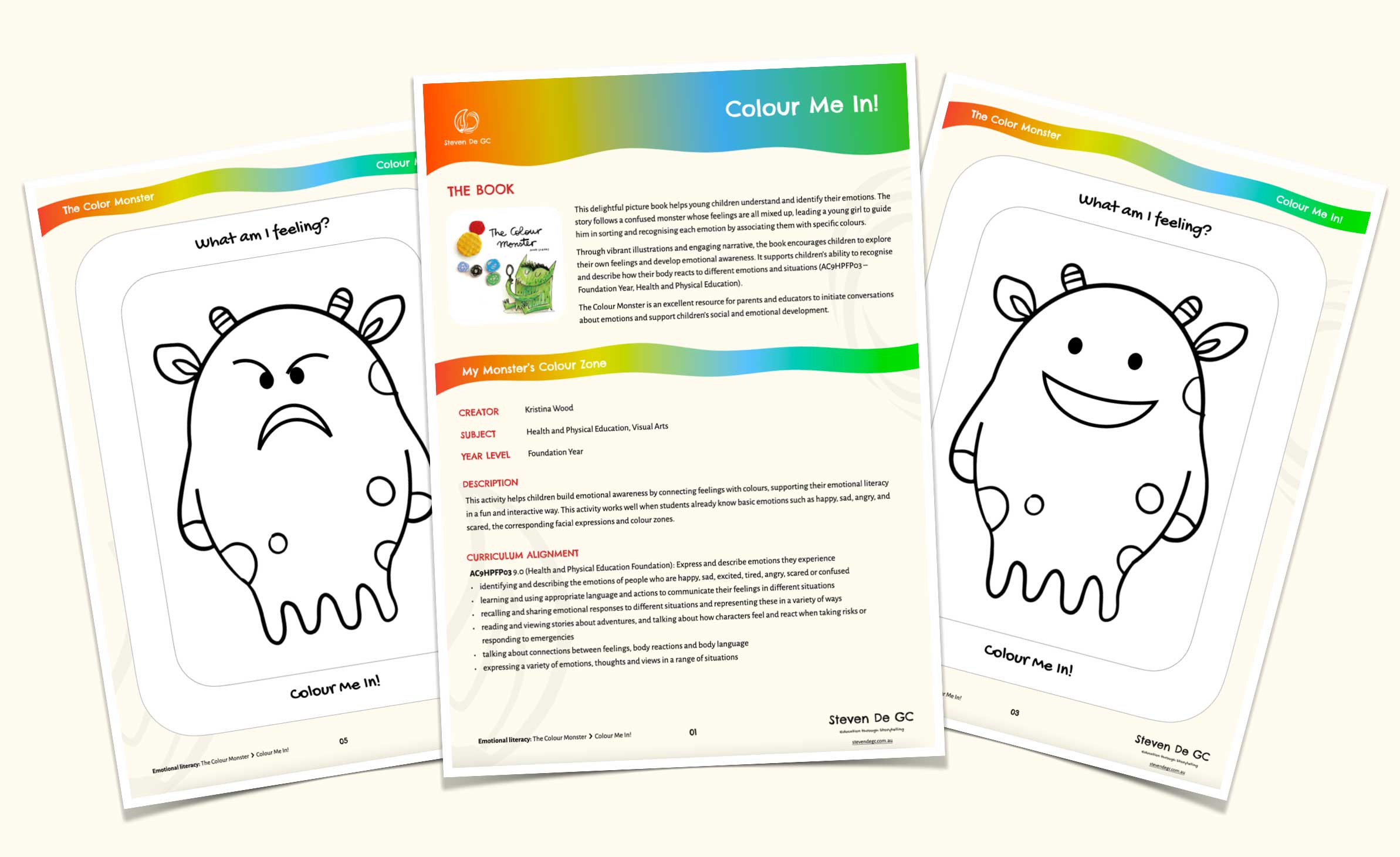
• Students are learning to develop their ability to identify the colour zone of feelings.
This delightful picture book helps young children understand and identify their emotions. The story follows a confused monster whose feelings are all mixed up, leading a young girl to guide him in sorting and recognising each emotion by associating them with specific colours.
Through vibrant illustrations and engaging narrative, the book encourages children to explore their own feelings and develop emotional awareness. It supports children’s ability to recognise and describe how their body reacts to different emotions and situations (AC9HPFP03 – Foundation Year, Health and Physical Education).
The Colour Monster is an excellent resource for parents and educators to initiate conversations about emotions and support children’s social and emotional development.
Discover engaging activities to teach shapes to Foundation Year students using storytelling with books like Shapes with Little Fish, Shapes at the Party and Shapes of Australia. Combine fun and learning seamlessly!
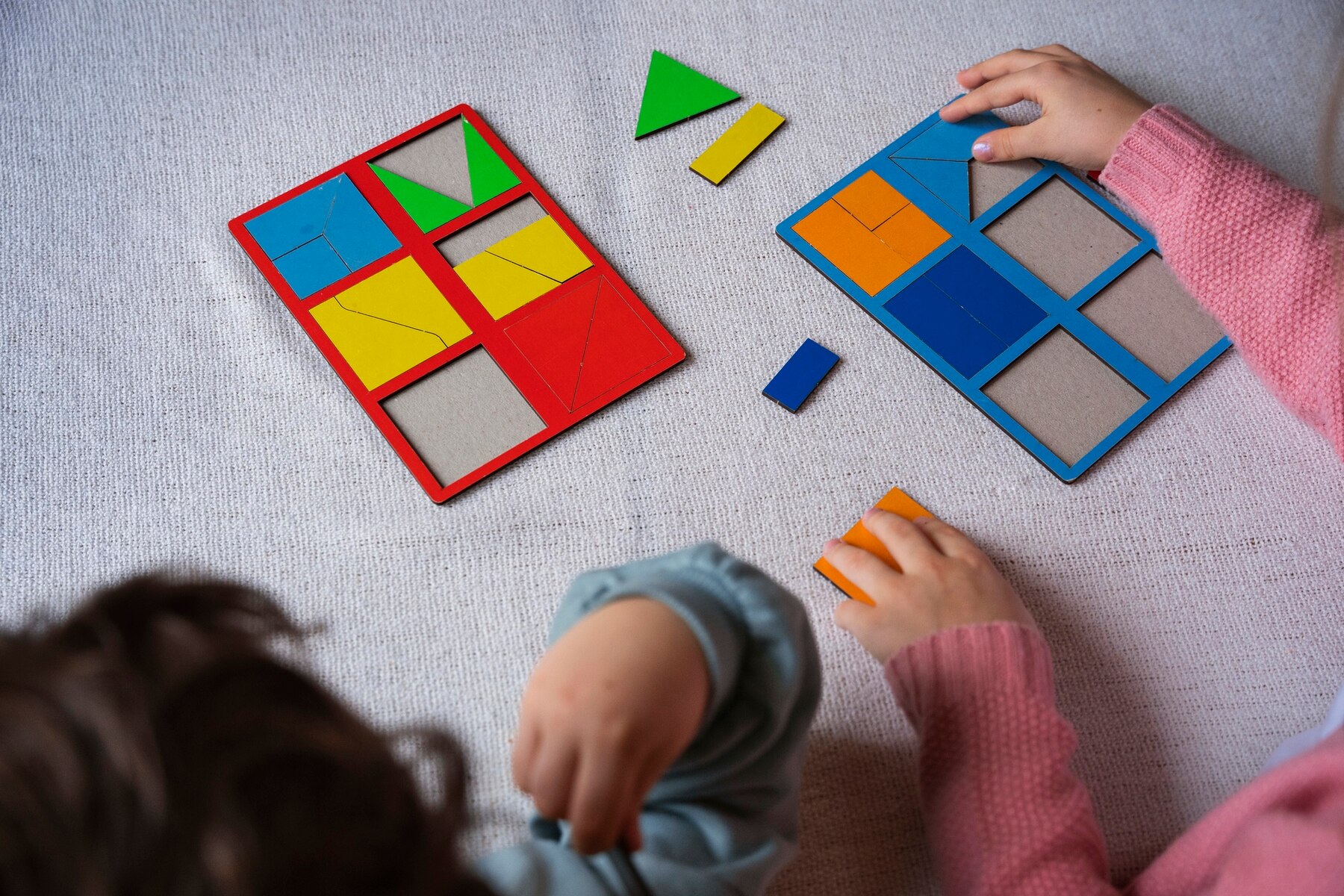
• Students are learning to identify and match basic shapes.
Shapes with Little Fish is a bright and engaging picture book that introduces young children to basic shapes through playful underwater adventures. The book helps early learners name, describe and trace shapes (AC9MFSP01, ACMMG009 – Foundation Year, Mathematics) through simple, rhythmic text (AC9EFLY09, ACELA1439 – Foundation Year, English), which also supports reading while fostering early geometric awareness. In addition, the cheerful character of Little Fish guides readers through a lively exploration of shape recognition in an accessible and interactive way.
• We are learning to recognise 2D shapes in everyday objects.
This vibrant and engaging book introduces young readers to the concept of shapes in a fun and playful setting. Through its dynamic illustrations, children explore a variety of shapes—such as circles, triangles, and squares—while following the excitement of a party scene. The book aligns with AC9MFSP01 (Foundation Year, Mathematics), which focuses on identifying and describe familiar two-dimensional shapes within objects in the environment. As children engage with the visuals, they develop geometric awareness and recognition skills in an enjoyable and meaningful context. With its bold artwork and interactive storytelling, Shapes at the Party fosters curiosity and learning through real-world applications of geometry, making it a valuable resource for early mathematical exploration.
• Students learn to identify, sort, and name familiar 2D shapes
The book is an artistic exploration of Australia’s diverse landscapes through the lens of geometric shapes. The book introduces young readers to the natural world by identifying and describing various shapes found in the environment, such as circles in the treetops, triangles in the mountains, and spirals in shells. This aligns with the learning objective AC9MFSP01, ACMMG006 (Mathematics, Foundation Year), which focuses on identifying and describing familiar two-dimensional shapes in the environment. Additionally, the book supports AC9AVAFD01, ACAVAM106 (Visual Arts, Foundation Year) by encouraging young readers to explore how visual arts express ideas about the world. Through Bancroft’s detailed and culturally rich illustrations, children learn to interpret and appreciate the unique beauty of Country through the use of shapes and patterns in visual storytelling. This beautifully illustrated book not only enhances children’s geometric understanding but also deepens their appreciation for the visual arts, making it a valuable resource for integrated learning in mathematics and art.
Engage kids with maths through storytelling! Discover children’s books and hands-on activities to teach counting and numbers in fun, interactive ways aligned with the Australian Curriculum.
• Students will practise counting numbers up to 10.
• Students are practising basic counting skills up to 10.
• Students are learning to count backwards through the one-less number concept.
This delightful rhyming adventure captivates young readers with its playful text and vibrant illustrations. The story counts down from 10 to 1 as a group of mischievous little dinosaurs encounters various adventures and challenges, blending humour with basic counting skills (ACMNA001, AC9MFN01 – Foundation Year, Mathematics). It connects number names, numerals, and the number of dinosaurs (ACMNA002 – Foundation Year, Mathematics), making it a valuable tool for early numeracy. The rhymes and repetitive patterns not only entertain but also foster language development and phonemic awareness (ACELA1439 – Foundation Year, English). With its engaging narrative and educational focus, Ten Little Dinosaurs is a perfect read-aloud choice for young children, combining fun and learning in one enjoyable package.