

N/A

$5 Off First Order + 5% Off After
Become a free registered member and get access to exclusive discounts, resources, and a community of like-minded educators.
Not sure yet? See what you’ll get: Member benefits
The Shouting Girl Colouring
The Book

The Shouting Girl
Written by Steven Huynh, illustrated by Gehenna Pham, published by Steven De GC
The story follows a young girl who struggles to express herself calmly, often shouting when she feels frustrated or unheard. Through her journey, she learns to recognise and understand her emotions (AC9HPFP03, AC9HP2P03 – Foundation to Year 2, Health and Physical Education) and works to develop positive strategies for expressing her thoughts and feelings in respectful ways (AC9HPFP02, AC9HP2P02 – Foundation to Year 2, Health and Physical Education).
The story also encourages children to explore characters’ perspectives and emotional responses, fostering empathy (AC9HP2P01 – Health and Physical Education, Years 1 and 2). It helps them define safe and unsafe environments, such as calm corners, through interactions with friends in a classroom, establishing help-seeking strategies in such situations (AC9HP2P05 – Health and Physical Education, Years 1 and 2).
With its poetic language and engaging illustrations, The Shouting Girl helps students understand how rhyme and rhythm create cohesion in a text. It also explores how words and images shape settings and characters, along with other literary features such as lists of three and similes.
Resource creator
Steven Huynh
Subject
Level
Learning Intentions
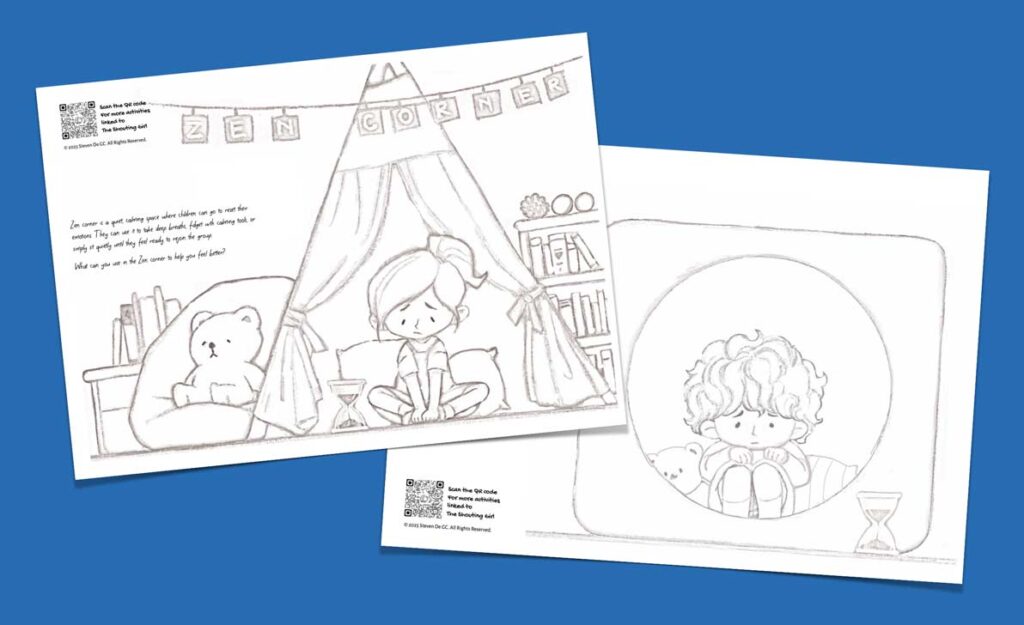
• Children are learning about safe spaces
• Children colour in the sheets.
Successful Criteria
• I know where I go to reset my big emotions.
• I know what to do in safe, calm spaces.
• I colour in the sheets.
Curriculum Alignment
AC9HP2P03 9.0 (Health and Physical Education Year 1, Year 2): Identify how different situations influence emotional responses
• recognising own emotions and demonstrating ways to manage how they express their emotions in different situations
• exploring self-regulation strategies to manage emotional responses
• identifying situations that may trigger strong emotional responses in themselves and others, and recognising the impact the responses can have on others
• identifying how someone might feel, think and act during an emergency through role-play and imaginative play
• predicting how a person or character might be feeling based on the words they use, their facial expressions and body language
• recognising how self and others are feeling in a range of situations
ACAVAM107 8.4 (Visual Arts Foundation, Year 1, Year 2): Use and experiment with different materials, techniques, technologies and processes to make artworks
• exploring a range of natural and man-made materials and technologies to visually express their experiences, for example, paint, pencils, ink, sand, photography and graphically
• comparing the qualities and properties of materials such as paint, crayons, clay and found objects and select appropriate applications to represent something or someone they like
• using techniques to demonstrate various compositional effects, for example, overlapping or crosshatching
• following technical processes and safe practices to make artworks, for example, drawing onto Styrofoam to print on paper
Materials
- The Shouting Girl’s colouring sheets
Instructions
Downloads
Leave a Reply