Resource creator
Lian Khanh
Description
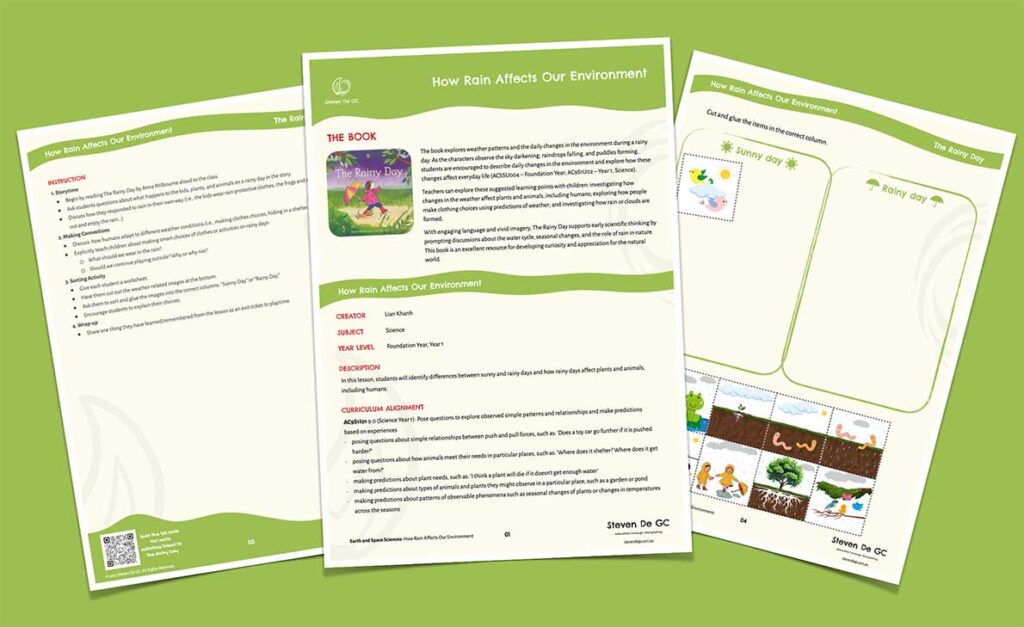
In this lesson, students will identify differences between sunny and rainy days and how rainy days affect plants and animals, including humans.
Learning Intentions
โข We are learning how rainy weather affects plants, animals, and people.
Successful Criteria
โข I can share my ideas about rainy and sunny days.
โข I can sort and categorise weather-related images correctly.
โข I can explain how people and animals adapt to different weather.
Curriculum Alignment
AC9S1I01 9.0 (Science Year 1): Pose questions to explore observed simple patterns and relationships and make predictions based on experiences
โข posing questions about simple relationships between push and pull forces, such as: โDoes a toy car go further if it is pushed harder?โ
โข posing questions about how animals meet their needs in particular places, such as: โWhere does it shelter? Where does it get water from?โ
โข making predictions about plant needs, such as: โI think a plant will die if it doesnโt get enough waterโ
โข making predictions about types of animals and plants they might observe in a particular place, such as a garden or pond
โข making predictions about patterns of observable phenomena such as seasonal changes of plants or changes in temperatures across the seasons
AC9S1U02 9.0 (Science Year 1): Describe daily and seasonal changes in the environment and explore how these changes affect everyday life
โข making and recording observations of phenomena such as changes to weather, seasonal changes to plants such as colour or dropping of leaves, and growth of flowers or fruit
โข noticing how daily weather indicators and seasonal patterns help us to make plans for activities in our daily lives
โข investigating how seasonal changes affect plants and animals, including animals that hibernate and migrate
โข investigating how changes in the weather affect plants and animals, including humans
โข exploring how people make clothing choices using predictions of weather or knowledge of seasonal changes
โข recognising the extensive knowledges of daily and seasonal changes in weather patterns and landscape held by First Nations Australians
โข exploring how First Nations Australiansโ concepts of time and weather patterns explain how things happen in the world around them
ACSIS014 8.4 (Science Foundation): Pose and respond to questions about familiar objects and events
โข considering questions relating to the home and school and objects used in everyday life
ACSSU004 8.4 (Science Foundation): Daily and seasonal changes in our environment affect everyday life
โข learning how Aboriginal and Torres Strait Islander Peoplesโ concepts of time and weather patterns explain how things happen in the world around them (OI.3, OI.5)
โข linking the changes in the daily weather to the way we modify our behaviour and dress for different conditions, including examples from different cultures
โข investigating how changes in the weather might affect animals such as pets, animals that hibernate, or migratory animals
Instructions
1. Storytime
- Begin by reading The Rainy Day by Anna Milbourne aloud to the class.
- Ask students questions about what happens to the kids, plants, and animals on a rainy day in the story.
- Discuss how they responded to rain in their own way (i.e., the kids wear rain protective clothes; the frogs and worms come out and enjoy the rain…)
2. Making Connections
- Discuss: how humans adapt to different weather conditions (i.e., making clothes choices, hiding in a shelter…)
- Explicitly teach children about making smart choices of clothes or activities on rainy days:
- What should we wear for rainy days?
- Should we continue playing outside? Why or why not?
3. Sorting Activity
- Give each student a worksheet.
- Have them cut out the weather-related images at the bottom.
- Ask them to sort and glue the images into the correct columns: “Sunny Day” or “Rainy Day.”
- Encourage students to explain their choices.
4. Wrap-up
- Share one thing they have learned/remembered from the lesson as an exit ticket to playtime.
Extensions
Let students illustrate their own Rainy Day Adventure, for example capturing moments like frogs hopping on the Lilly pads or the path, birds taking shelter in their nests, or other children wearing raincoats, boots, and carrying umbrellas.
Downloads
Related Activities
-
Science
-
English Language and Literacy and Science
-
Science
-
Science
-
Science
-
Science and Visual Arts
๐
by Eric Carle
โข We are learning to observe how clouds change shape and move in the sky.
-
Science
Leave a Reply